
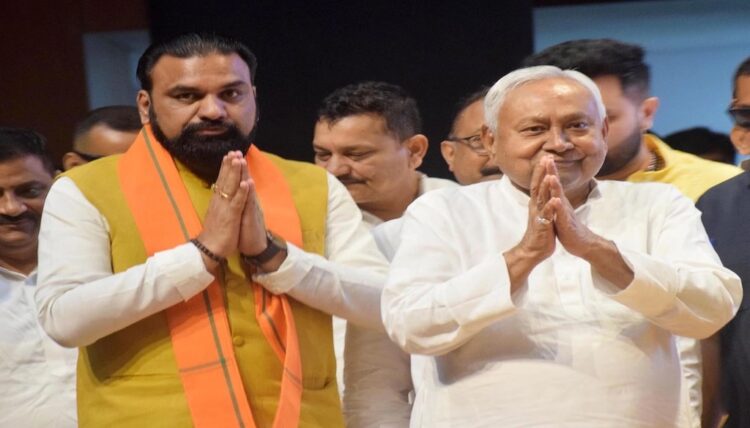
Patna: In a significant administrative change not seen in nearly two decades, Bihar Chief Minister Nitish Kumar has given up control of the state’s Home Department, which he has managed since 2005, contributing to his reputation as “Sushashan Babu.” This influential department, responsible for the police, CID, STF, Special Branch, Bihar Special Armed Forces, Government Railway Police, and Economic Offences Unit, has been transferred to his deputy, Samrat Chaudhary. Currently in his second term as deputy chief minister, Samrat is among the most prominent figures of the BJP in the state and has been the party’s Bihar unit president since 2023.
His new role in the Home Department grants him extensive power over policing and law enforcement, particularly as Bihar’s governance is under intense public and political observation. The decision comes amid political controversies. During the election campaign, Jan Suraaj founder Prashant Kishor brought up allegations from a 1995 case in Munger’s Tarapur constituency, where Samrat was implicated as a young political aspirant in the murder of seven individuals. While Samrat has consistently denied any wrongdoing and no convictions have been reported, the issue gained traction during the contentious campaign.
Nevertheless, Samrat now leads the very mechanisms responsible for crime management in the state — a move interpreted by analysts as a clear signal of the BJP’s enhanced power within the coalition. Samrat’s political journey has been extensive and cross-party. Hailing from a prominent political lineage — his father, Shakuni Chaudhary, served as the representative of Tarapur six times since 1985, and his mother, Parvati Devi, was also an MLA — he began his career with the RJD in 1999 and became a minister in the Rabri Devi government. He won the Parbatta seat in 2000 and retained it in 2010 before transitioning to the JD(U) and then the BJP in 2017.


Within the BJP, his rise was swift: state vice-president, MLC, state party president, and finally, deputy chief minister in January 2024. His new responsibility overseeing Bihar’s law-and-order framework places him at the forefront of the state’s governance. For Nitish Kumar, who has traditionally maintained control over key departments to manage internal coalitions, this change signifies a rare delegation of power. For the BJP, it indicates a solidification of influence in a government where it already holds a majority of cabinet roles. Whether this transition will alter Bihar’s political scene or governance outcomes is still uncertain, but the message is clear: in the evolving NDA framework, power is being redistributed, and the BJP’s presence is stronger than ever.